BioAcyl Corp

BioAcyl Corp |
|
 |
 |
 |

|
Pappas, G., Wilkinson, M. L., & Gow, A. J. (2023). Nitric oxide regulation of cellular metabolism: Adaptive tuning of cellular energy. Nitric Oxide, 131, 8–17. Added by: Dr. Enrique Feoli (01/03/2026, 18:39) Last edited by: Dr. Enrique Feoli (01/03/2026, 18:53) |
 |
| Resource type: Journal Article Published DOI: 10.1016/j.niox.2022.11.006 ID no. (ISBN etc.): 1089-8603 BibTeX citation key: Pappas2023 View all bibliographic details  |
Categories: BioAcyl Corp Subcategories: Entero-salivary cycle Keywords: Cellular respiration, Exercise, glycolysis, Metabolism, Mitochondria, nitric oxide Creators: Gow, Pappas, Wilkinson Collection: Nitric Oxide |
Views: 29/90
|
| Abstract |
|
Nitric oxide can interact with a wide range of proteins including many that are involved in metabolism. In this review we have summarized the effects of NO on glycolysis, fatty acid metabolism, the TCA cycle, and oxidative phosphorylation with reference to skeletal muscle. Low to moderate NO concentrations upregulate glucose and fatty acid oxidation, while higher NO concentrations shift cellular reliance toward a fully glycolytic phenotype. Moderate NO production directly inhibits pyruvate dehydrogenase activity, reducing glucose-derived carbon entry into the TCA cycle and subsequently increasing anaploretic reactions. NO directly inhibits aconitase activity, increasing reliance on glutamine for continued energy production. At higher or prolonged NO exposure, citrate accumulation can inhibit multiple ATP-producing pathways. Reduced TCA flux slows NADH/FADH entry into the ETC. NO can also inhibit the ETC directly, further limiting oxidative phosphorylation. Moderate NO production improves mitochondrial efficiency while improving O2 utilization increasing whole-body energy production. Long-term bioenergetic capacity may be increased because of NO-derived ROS, which participate in adaptive cellular redox signaling through AMPK, PCG1-α, HIF-1, and NF-κB. However, prolonged exposure or high concentrations of NO can result in membrane depolarization and opening of the MPT. In this way NO may serve as a biochemical rheostat matching energy supply with demand for optimal respiratory function.
Added by: Dr. Enrique Feoli Last edited by: Dr. Enrique Feoli |
| Notes |
|
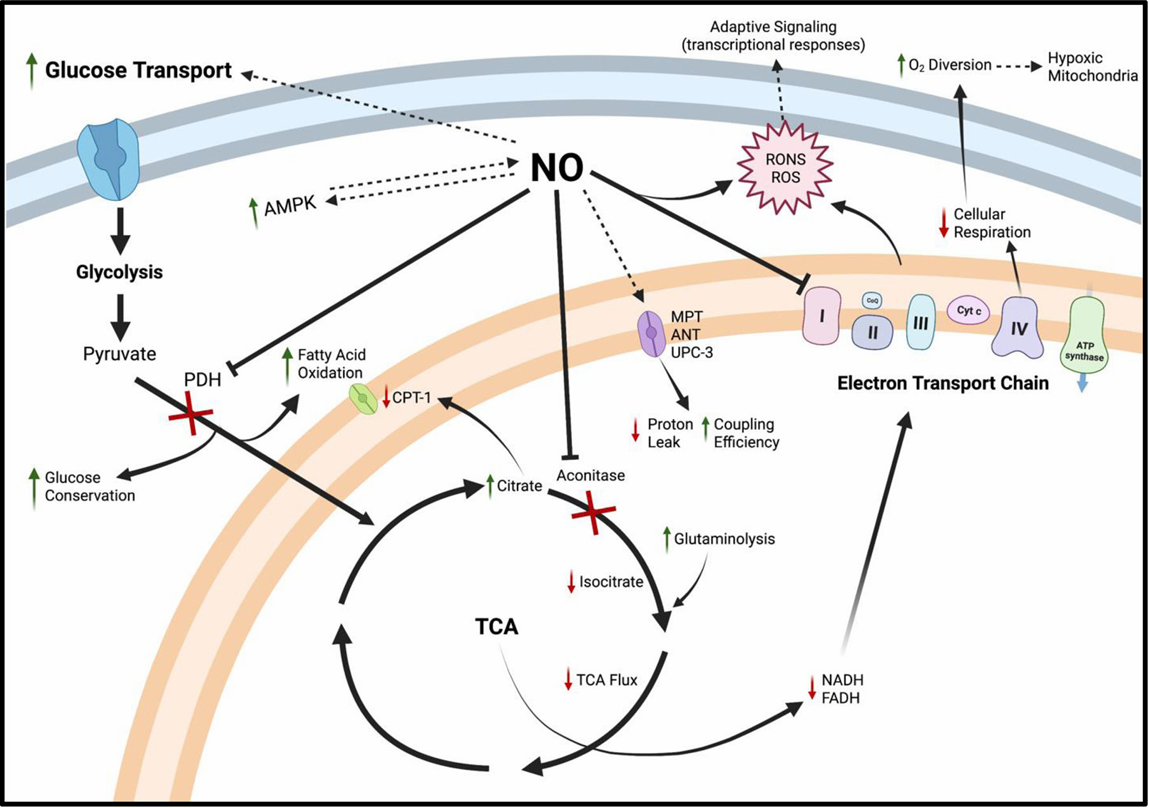
Low to moderate NO concentrations upregulate glucose and fatty acid oxidation via multiple pathways, while higher NO concentrations serve to shift cellular reliance away from fatty acid oxidation and cellular respiration toward a fully glycolytic phenotype. NO-induced AMPK activation mediates GLUT4 expression on the cell surface membrane and increased glycolytic flux. AMPK enhances NO production via NOS phosphorylation. Moderate NO production within the cytosol directly inhibits PDH, reducing glucose-derived carbon entry into the TCA, the use of fatty acids for energy while conserving lactate and pyruvate for utilization in other anabolic pathways. Within the mitochondria, NO directly inhibits aconitase, increasing TCA reliance on glutamine for continued energy production. At higher or prolonged NO exposure, subsequent citrate accumulation can inhibit multiple ATP-producing pathways, including CPT-1 and several glycolytic enzymes (not shown). Reduced TCA flux slows NADH/FADH entry into the respiratory chain, which also experiences direct NO inhibition at complex IV. Minor inhibition of the ETC, with increased glucose transport and decreased fatty acid oxidation, serves to increase glycolytic flux during high energy demand (i.e., exercise). Moderate NO production can also improve mitochondrial efficiency via decreased expression of ANT and UPC-3 across the inner membrane while improving O2 utilization by diverting O2 toward more hypoxic tissue, increasing whole-body energy production. Long-term bioenergetic capacity may be increased because of NO-derived ROS, which are able to cross the mitochondrial membrane and participate in adaptive cellular redox signaling primarily through AMPK, PCG1-α, HIF-1, and NF-κB. However, prolonged exposure or high concentrations of NO results in membrane depolarization and opening of the MPT, excessive and potentially damaging ROS production, and the shift from oxidative phosphorylation toward total reliance on less Added by: Dr. Enrique Feoli Last edited by: Dr. Enrique Feoli |