BioAcyl Corp

BioAcyl Corp |
|
 |
 |
 |

|
Jones, D. P., & Sies, H. (2015). The Redox Code. Antioxidants & Redox Signaling, 23(9), 734–746. Added by: Dr. Enrique Feoli (11/10/2020, 17:01) Last edited by: Dr. Enrique Feoli (17/01/2021, 19:56) |
 |
| Resource type: Journal Article Published DOI: 10.1089/ars.2015.6247 ID no. (ISBN etc.): 1523-0864 BibTeX citation key: Jones2015 View all bibliographic details  |
Categories: BioAcyl Corp Subcategories: Redox microenvironment Creators: Jones, Sies Collection: Antioxidants & Redox Signaling |
Views: 19/299
|
| Abstract |
|
Significance: The redox code is a set of principles that defines the positioning of the nicotinamide adenine dinucleotide (NAD, NADP) and thiol/disulfide and other redox systems as well as the thiol redox proteome in space and time in biological systems. The code is richly elaborated in an oxygen-dependent life, where activation/deactivation cycles involving O2 and H2O2 contribute to spatiotemporal organization for differentiation, development, and adaptation to the environment. Disruption of this organizational structure during oxidative stress represents a fundamental mechanism in system failure and disease. Recent Advances: Methodology in assessing components of the redox code under physiological conditions has progressed, permitting insight into spatiotemporal organization and allowing for identification of redox partners in redox proteomics and redox metabolomics. Critical Issues: Complexity of redox networks and redox regulation is being revealed step by step, yet much still needs to be learned. Future Directions: Detailed knowledge of the molecular patterns generated from the principles of the redox code under defined physiological or pathological conditions in cells and organs will contribute to understanding the redox component in health and disease. Ultimately, there will be a scientific basis to a modern redox medicine. Antioxid. Redox Signal. 23, 734?746.
Added by: Dr. Enrique Feoli Last edited by: Dr. Enrique Feoli |
| Notes |
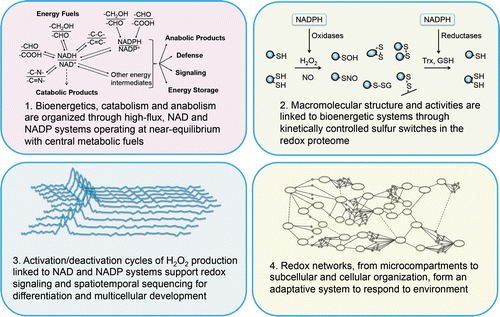
The redox code consists of four principles by which biological systems are organized (Fig. 1). The first is the use of the reversible electron accepting and donating properties of nicotinamide in NAD and NADP to provide organization of metabolism, operating at near equilibrium. Substrate oxidations are linked to reduction of NAD+ and NADP+, which in turn are linked to ATP production, catabolism, and anabolism, respectively. The second principle is that metabolism is linked to protein structure through kinetically controlled redox switches in the proteome, which determine tertiary structure, macromolecular interactions and trafficking, activity, and function. The abundance of proteins and reactivity of sulfur switches with oxidants vary over several orders of magnitude to determine specificity in biological processes. The third principle is that of redox sensing, in that activation/deactivation cycles of redox metabolism, especially involving H2O2, support spatiotemporal sequencing in differentiation and life cycles of cells and organisms. The fourth principle is that redox networks form an adaptive system to respond to the environment from microcompartments through subcellular systems to the levels of cell and tissue organization. This adaptive redox network structure is required to maintain health in a changing environment and, if functionally impaired, contributes to disease and organism failure.
Added by: Dr. Enrique Feoli Last edited by: Dr. Enrique Feoli |