BioAcyl Corp

BioAcyl Corp |
|
 |
 |
 |
|
Gillings, M., Paulsen, I., & Tetu, S. (2015). Ecology and evolution of the human microbiota: Fire, farming and antibiotics. Genes, 6(3), 841–857. Added by: Dr. Enrique Feoli (29/07/2023, 16:17) Last edited by: Dr. Enrique Feoli (29/07/2023, 17:46) |
 |
| Resource type: Journal Article DOI: 10.3390/genes6030841 ID no. (ISBN etc.): 2073-4425 BibTeX citation key: Gillings2015 View all bibliographic details  |
Categories: BioAcyl Corp Subcategories: Microbiota on immunity Creators: Gillings, Paulsen, Tetu Collection: Genes |
Views: 2/710
|
| Notes |
|
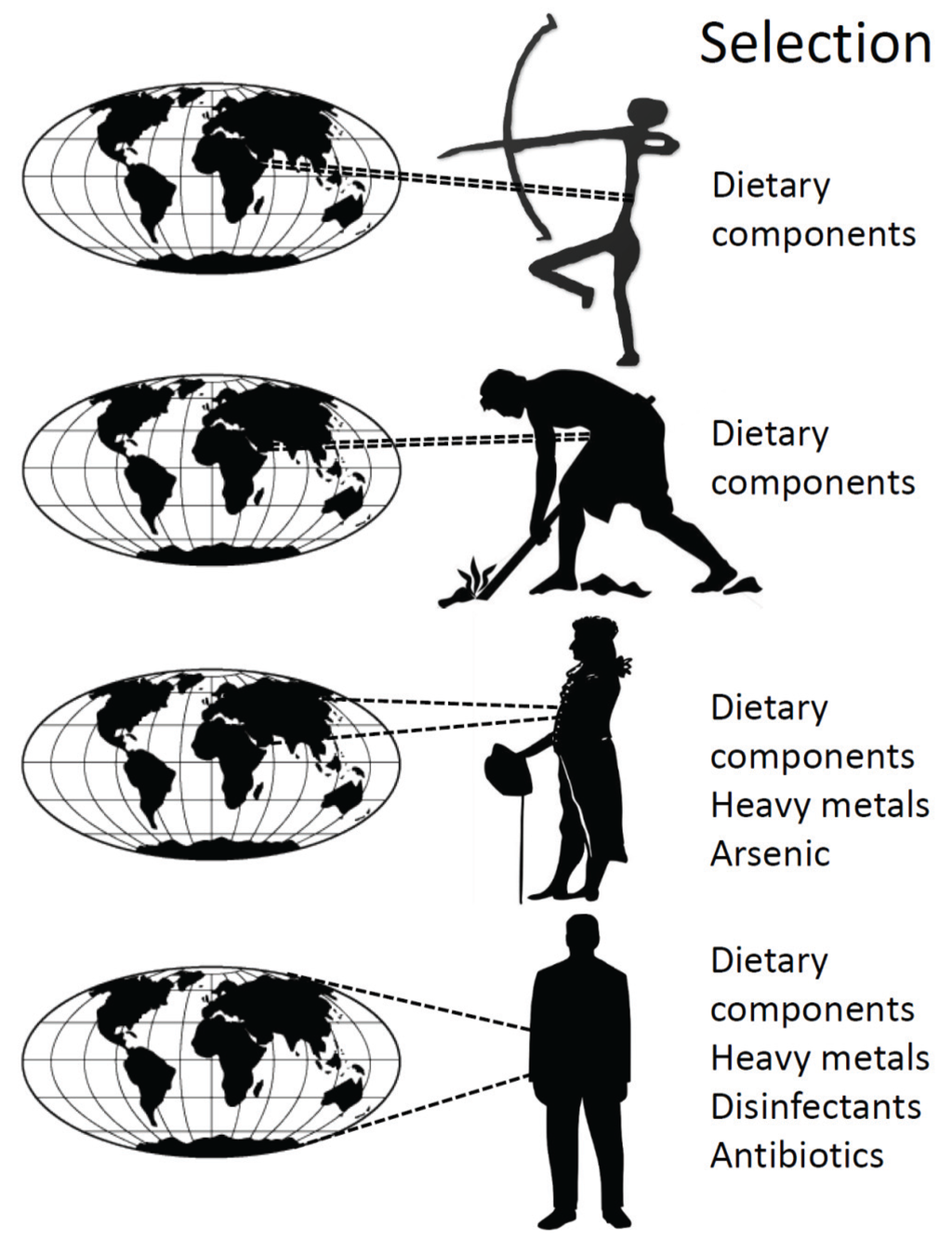
Schematic history of selective forces acting on the human microbiome and microbiota. As human populations moved from hunter-gatherer, to agrarian communities, to the industrial revolution, to modern civilization (vertical dimension), the selective forces on the microbiota and microbiome have changed. Early selection was mainly driven by ability to metabolize dietary components, while more recently, strong selective agents such as heavy metals and antimicrobial agents have become increasingly important. In addition, the potential sources of both microbiota and microbiome components (species and genes) have broadened as mass movement of materials and organisms became a feature of a globalized world. |
| Quotes |
|
It is useful to think of each individual human as a microbial island, colonized and populated by microorganisms. From this perspective, many of the principles of island biogeography become useful and informative. The human body is originally colonized by microorganisms from relatives, and from the environment, and these assemblages undergo progressive changes to reach a final, climax community as an adult [88,89]. In the modern world, declining microbial exposure and decreased α-diversity in our relatives limits the diversity of potential colonizers, and thus makes the eventual climax community less predictable. Each island of microorganisms is also then exposed to different agents of selection, which preferentially remove some elements of the assemblage, and lower α-diversity at both species and genetic levels [83,85,90]. Each island experiences these perturbations at different times, with different agents of selection, and thus each human microbial island has a different ecological and evolutionary history. This sequential series of independent bottlenecks [85,91] then generates the elevated β-diversity that characterizes modern populations [11,74].
Added by: Dr. Enrique Feoli
(2023-07-29 16:49:46)
|