BioAcyl Corp

BioAcyl Corp |
|
 |
 |
 |
|
Liang, X., Huang, X., & Zhou, Y. (2016). Mechanical Stretching Promotes Skin Tissue Regeneration via Enhancing Mesenchymal Stem Cell Homing and Transdifferentiation. STEM CELLS Translational Medicine, 5(7), 960–969. Added by: Dr. Enrique Feoli (12/04/2025, 19:31) Last edited by: Dr. Enrique Feoli (12/04/2025, 19:38) |
 |
| Resource type: Journal Article Published DOI: 10.5966/sctm.2015-0274 ID no. (ISBN etc.): 2157-6564 BibTeX citation key: Liang2016 View all bibliographic details  |
Categories: BioAcyl Corp Subcategories: Dermotaxis Creators: Huang, Liang, Zhou Collection: STEM CELLS Translational Medicine |
Views: 24/50
|
| Abstract |
|
To clarify the underlying mechanisms of how mesenchymal stem cells (MSCs) promote skin expansion and help ameliorate complications, the authors identified the differentially expressed genes between mechanically stretched human MSCs and controls. Microarray analysis suggested upregulation of genes related to hypoxia, vascularization, and cell proliferation, enhancing transplanted MSC homing to the expanded skin and transdifferentiation into epidermal basal cells and endothelial cells.
|
| Notes |
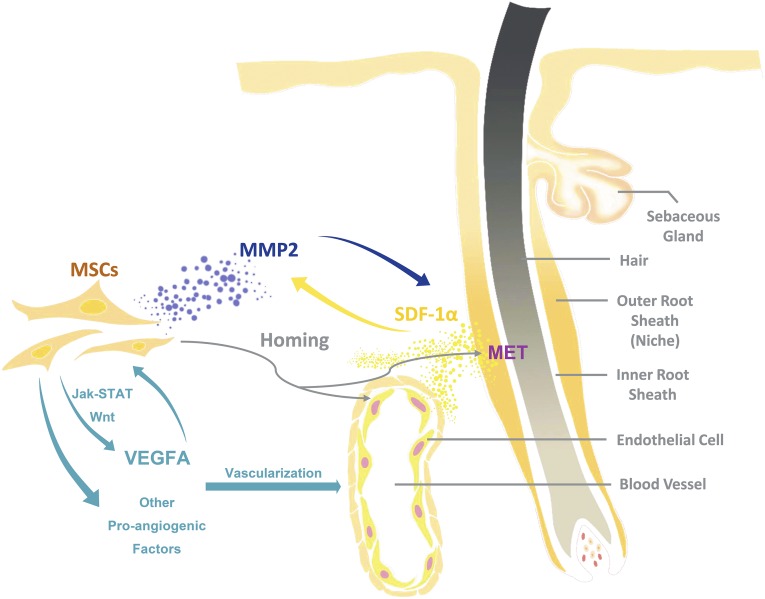 Schematic diagram of the homing and transdifferentiation of transplanted MSCs. Mechanical stretching might enhance MSC homing to the outer root sheath of hair follicles and blood vessels through feedback between MMP2 and the SDF-1α/C-X-C chemokine receptor 4 axis. MSCs transdifferentiate into KRT14+ cells in the microenvironment of the hair follicle stem cell niche, and into CD31+ cells in blood vessels. MSCs promote vascularization in the expanded skin through upregulation of VEGFA (via the Jak-STAT and Wnt signaling pathways) and other proangiogenic factors. Abbreviations: Jak-STAT, Janus kinase/signal transducer and activator of transcription; KRT, keratin; MET, mesenchymal-epithelial transition; MMP, matrix metalloproteinase; MSC, mesenchymal stem cell; SDF, stromal cell-derived factor; VEGFA, vascular endothelial growth factor A. Schematic diagram of the homing and transdifferentiation of transplanted MSCs. Mechanical stretching might enhance MSC homing to the outer root sheath of hair follicles and blood vessels through feedback between MMP2 and the SDF-1α/C-X-C chemokine receptor 4 axis. MSCs transdifferentiate into KRT14+ cells in the microenvironment of the hair follicle stem cell niche, and into CD31+ cells in blood vessels. MSCs promote vascularization in the expanded skin through upregulation of VEGFA (via the Jak-STAT and Wnt signaling pathways) and other proangiogenic factors. Abbreviations: Jak-STAT, Janus kinase/signal transducer and activator of transcription; KRT, keratin; MET, mesenchymal-epithelial transition; MMP, matrix metalloproteinase; MSC, mesenchymal stem cell; SDF, stromal cell-derived factor; VEGFA, vascular endothelial growth factor A.
Added by: Dr. Enrique Feoli Last edited by: Dr. Enrique Feoli |