BioAcyl Corp

BioAcyl Corp |
|
 |
 |
 |
|
Andrianova, N. V., Buyan, M. I., & Zorova, L. D. (2019). Kidney Cells Regeneration: Dedifferentiation of Tubular Epithelium, Resident Stem Cells and Possible Niches for Renal Progenitors. International Journal of Molecular Sciences, 20(24), 6326. Added by: Dr. Enrique Feoli (08/05/2025, 22:19) Last edited by: Dr. Enrique Feoli (08/05/2025, 22:25) |
 |
| Resource type: Journal Article Published DOI: 10.3390/ijms20246326 ID no. (ISBN etc.): 1422-0067 BibTeX citation key: Andrianova2019 View all bibliographic details  |
Categories: BioAcyl Corp Subcategories: Acute Kidney Injury Creators: Andrianova, Buyan, Zorova Collection: International Journal of Molecular Sciences |
Views: 19/51
|
| Abstract |
|
A kidney is an organ with relatively low basal cellular regenerative potential. However, renal cells have a pronounced ability to proliferate after injury, which undermines that the kidney cells are able to regenerate under induced conditions. The majority of studies explain yielded regeneration either by the dedifferentiation of the mature tubular epithelium or by the presence of a resident pool of progenitor cells in the kidney tissue. Whether cells responsible for the regeneration of the kidney initially have progenitor properties or if they obtain a “progenitor phenotype” during dedifferentiation after an injury, still stays the open question. The major stumbling block in resolving the issue is the lack of specific methods for distinguishing between dedifferentiated cells and resident progenitor cells. Transgenic animals, single-cell transcriptomics, and other recent approaches could be powerful tools to solve this problem. This review examines the main mechanisms of kidney regeneration: dedifferentiation of epithelial cells and activation of progenitor cells with special attention to potential niches of kidney progenitor cells. We attempted to give a detailed description of the most controversial topics in this field and ways to resolve these issues.
|
| Notes |
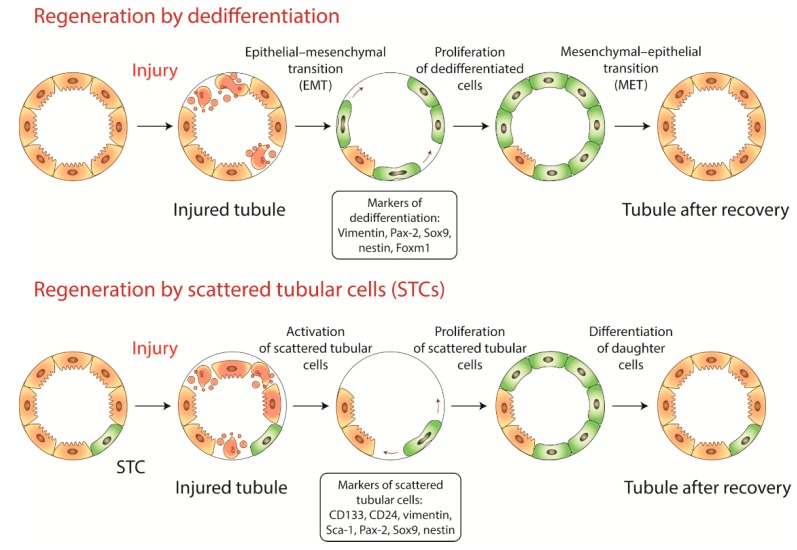
Two major putative mechanisms of kidney tissue regeneration: dedifferentiation of tubular epithelial cells and proliferation of resident renal progenitors with subsequent differentiation. Added by: Dr. Enrique Feoli Last edited by: Dr. Enrique Feoli |