BioAcyl Corp

BioAcyl Corp |
|
 |
 |
 |
|
Mukherjee, S., & Schäfer, L. V. (2023). Thermodynamic forces from protein and water govern condensate formation of an intrinsically disordered protein domain. Nature Communications, 14(1), 5892. Added by: Dr. Enrique Feoli (22/04/2026, 17:08) Last edited by: Dr. Enrique Feoli (22/04/2026, 17:13) |
 |
| Resource type: Journal Article Published DOI: 10.1038/s41467-023-41586-y ID no. (ISBN etc.): 2041-1723 BibTeX citation key: Mukherjee2023 View all bibliographic details  |
Categories: BioAcyl Corp Subcategories: Liquid-liquid phase separations Creators: Mukherjee, Schäfer Collection: Nature Communications |
Views: 1944/2238
|
| Abstract |
|
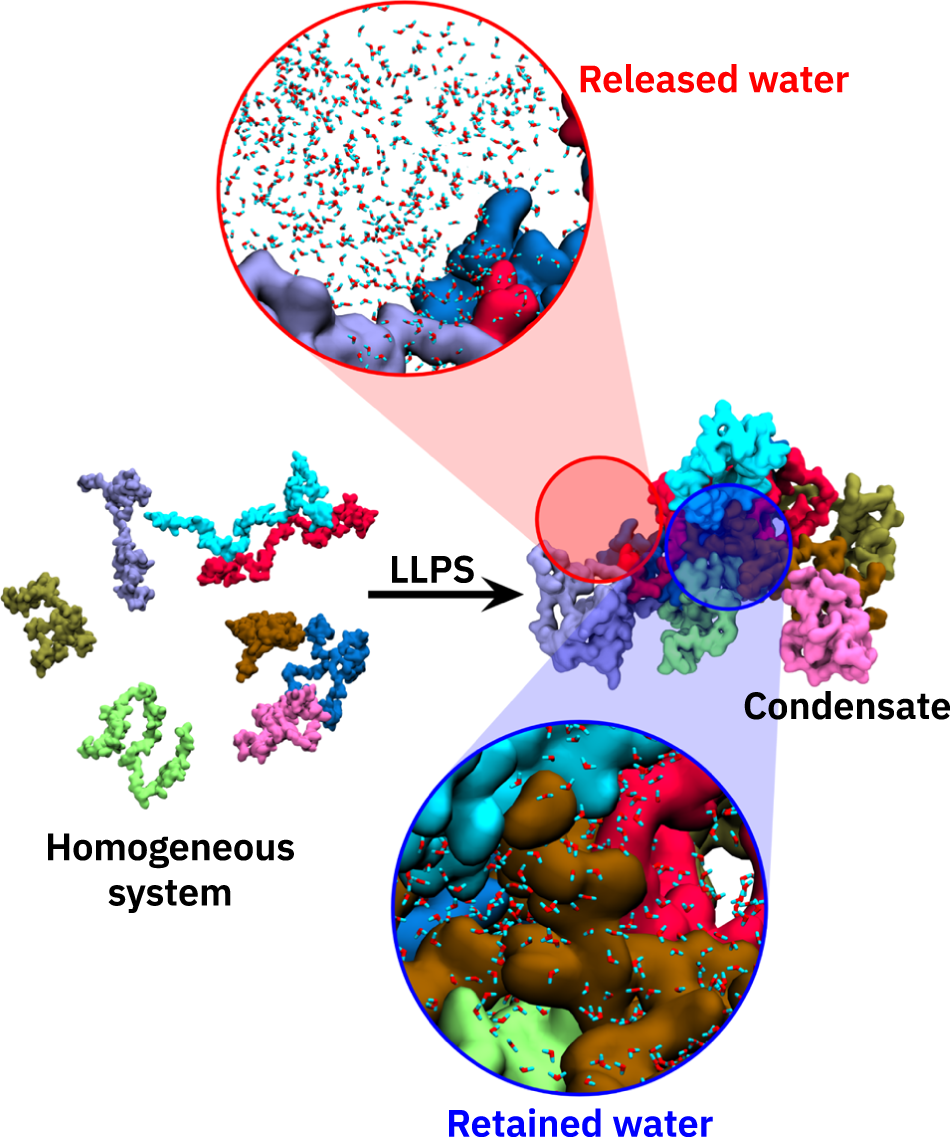
Liquid-liquid phase separation (LLPS) can drive a multitude of cellular processes by compartmentalizing biological cells via the formation of dense liquid biomolecular condensates, which can function as membraneless organelles. Despite its importance, the molecular-level understanding of the underlying thermodynamics of this process remains incomplete. In this study, we use atomistic molecular dynamics simulations of the low complexity domain (LCD) of human fused in sarcoma (FUS) protein to investigate the contributions of water and protein molecules to the free energy changes that govern LLPS. Both protein and water components are found to have comparably sizeable thermodynamic contributions to the formation of FUS condensates. Moreover, we quantify the counteracting effects of water molecules that are released into the bulk upon condensate formation and the waters retained within the protein droplets. Among the various factors considered, solvation entropy and protein interaction enthalpy are identified as the most important contributions, while solvation enthalpy and protein entropy changes are smaller. These results provide detailed molecular insights on the intricate thermodynamic interplay between protein- and solvation-related forces underlying the formation of biomolecular condensates.
Added by: Dr. Enrique Feoli Last edited by: Dr. Enrique Feoli |
| Notes |
|
The zoomed-in views highlight the water molecules that are released into a bulk-like environment (top) outside the protein condensate and the ones that are retained inside the condensate (bottom). Added by: Dr. Enrique Feoli Last edited by: Dr. Enrique Feoli |